

Decibel Range Charts and Hearing Info
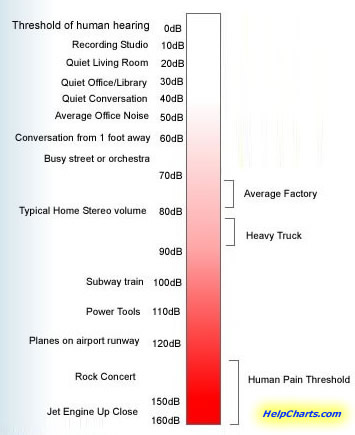
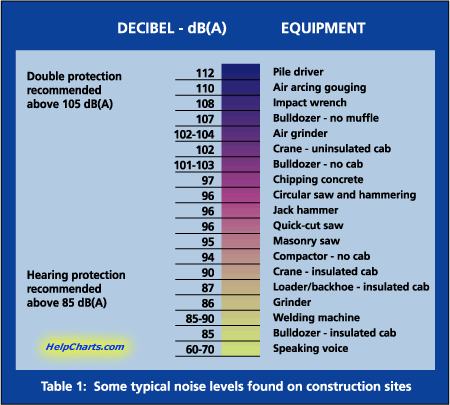
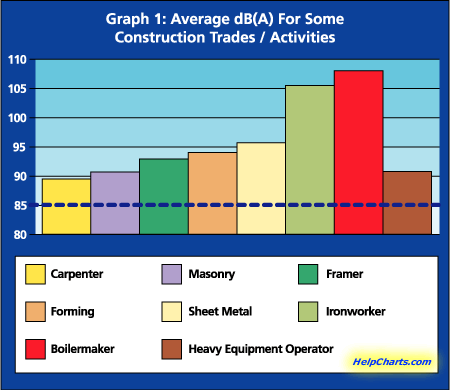
The charts on this page will show you different noise levels for specific jobs, tools, and various situations. The important thing to remember is to always protect your hearing for noise levels above 85 dB and use double protection if levels go over 105dB.
Once your hearing has been damaged it can't be fixed...So wear hearing protection....unless you like the idea of wearing a hearing aid all the time!
Decibel (dB) Range Charts - Click to Enlarge
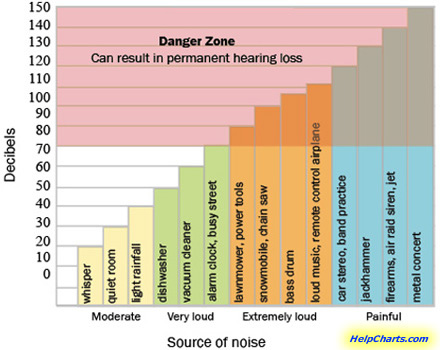
Decibel (dB) is the unit used to measure a sound's strength. The decibel scale is not linear but logarithmic. This means that noise levels can't be added directly like other numbers.
On the decibel scale, the smallest audible sound (near total silence) is 0 dB. A sound 10 times more powerful is 10 dB. A sound 100 times more powerful than near total silence is 20 dB. A sound 1,000 times more powerful than near total silence is 30 dB.
For example, a backhoe and a compressor each producing 90 dB have a combined output of 93 dB, not 180. But 93 dB is still twice as much noise as 90 dB. In other words, sound intensity doubles every 3 dB. Hearing protection should be used for any level over 85 dB and double protection for any level over 105 dB.
Sounds must also be specified in terms of frequency or pitch.
Most workplace noises include a wide band of frequencies and are measured through the "A" filter in sound-level meters.
The noise level is therefore expressed in decibels (dB) on the "A" scale, or dB(A).
Duration of exposure is equally important. Duration is typically measured over a workday and accumulated through many years.
The chart below shows different
types of power tools and their noise levels.
Always wear hearing protection for anything over 85 dB!
HOW MUCH PROTECTION DO YOU NEED? |
USE THIS CHART TO WORK OUT THE CORRECT GRADE OF HEARING PROTECTION FOR YOUR WORKPLACE: |
| HOW LOUD IS THE NOISE HAZARD | DECIBELS | TIME EXPOSED TO NOISE |
ALLOWABLE LEVEL |
NOISE LEVEL ABOVE LIMIT |
RECOMMENDED HEARING PROTECTION GRADE |
| BELT SANDER | 82-92 | 8 HOURS | 85 dBA | Up to 12 dBA | Grade 2 |
| BAND SAW | 94-95 | 4 HOURS | 88 dBA | ||
| TRUCK/TRACTOR | 90-110 | 2 HOURS | 91 dBA | ||
| SKILL SAW/CHAIN SAW | 95-110 | I HOUR | 94 dBA | Up to 18 dBA | Grade 3 |
| BAND SAW | 94-95 | 30 MINS | 97 dBA | ||
| WOOD PLANER | 94-96 | 15 MINS | 100 dBA | ||
| BRAKE RIVETTER | 97-99 | 8 MINS | 103 dBA | Up to 24 dBA | Grade 4 |
| GRINDER | 83-100 | 4 MINS | 106 dBA | ||
| ROUTER | 98-100 | 2 MINS | 109 dBA | ||
| GUILLOTINE | 94-103 | 1 MIN | 112 dBA | Up to 30 dBA | Grade 5 |
| WELDING MACHINE | 99-100 | 30 SECS | 115 dBA | ||
| CIRCULAR SAW | 100-106 | ||||
| IMPACT WRENCH | 104-107 | ||||
| DIESEL GENERATOR | 107-111 | ||||
| SAND BLASTING | 105-115 | ||||
| COMPRESSOR | 101-123 | ||||
| PNEUMATIC DRILL | 120-130 |
APPROVED HEARING PROTECTION GRADES |
| Hearing Protection Grade | Equivalent Continuous Sound level (8 Hours) |
Types of Approved Hearing Protection |
| 1 | 86-91 dB(A) | Earplugs/Earmuffs |
| 2 | 92-97 dB(A) | Earplugs/Earmuffs |
| 3 | 98-103 dB(A) | Earmuffs |
| 4 | 104-109 dB(A) | Earmuffs |
| 5 | 110-115 dB(A) | Earmuffs |
Normal Ear Function:
-
Sound is transmitted as sound waves from the environment. The sound waves are gathered by the outer ear and sent down the ear canal to the eardrum.
-
The sound waves cause the eardrum to vibrate, which sets the three tiny bones in the middle ear into motion.
-
The motion of the bones causes the fluid in the inner ear or cochlea to move.
-
The movement of the inner ear fluid causes the hair cells in the cochlea to bend. The hair cells change the movement into electrical pluses.
-
These electrical impulses are transmitted to the hearing (auditory) nerve and up to the brain, where they are interpreted as sound.